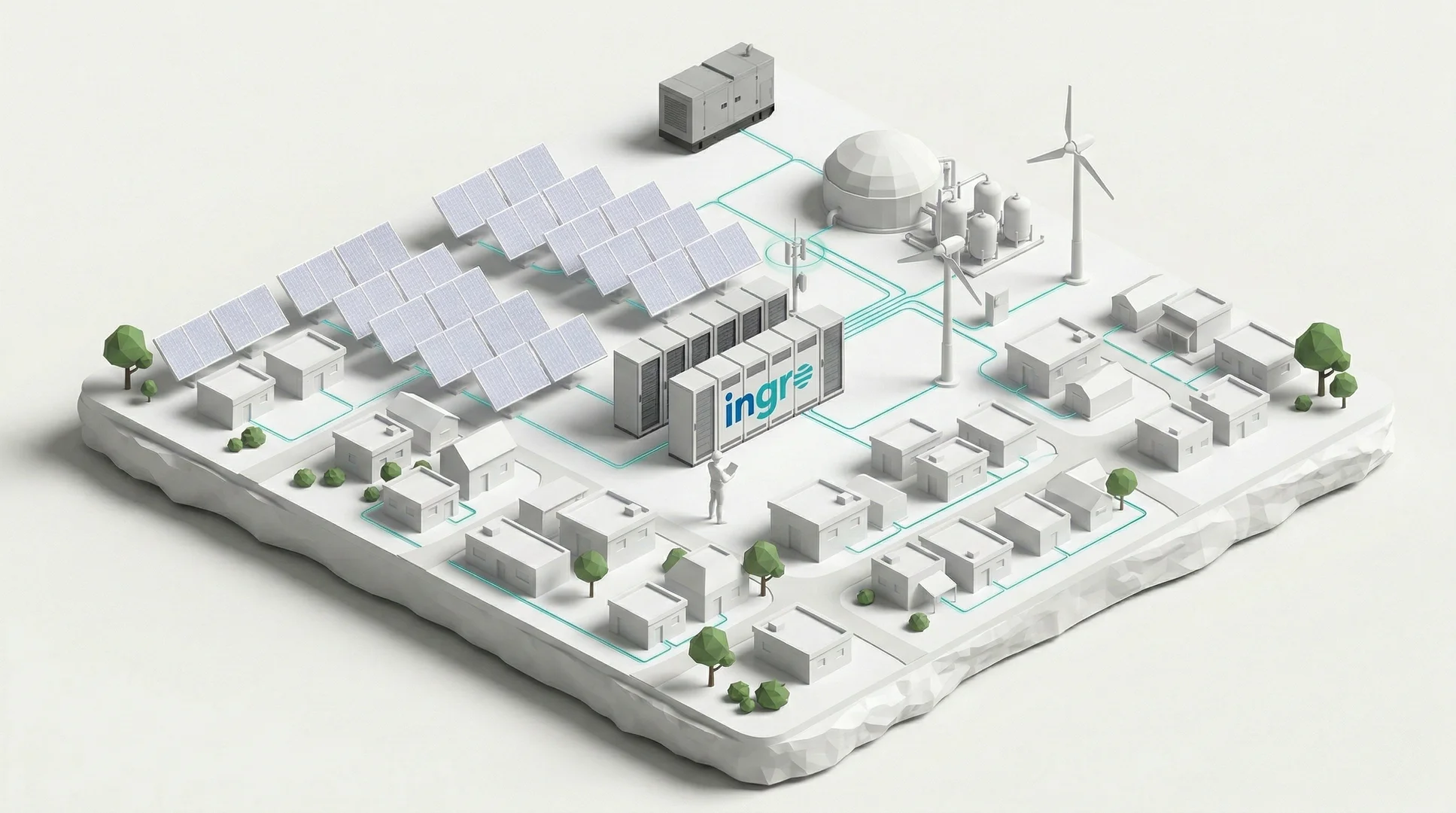
Solar+storage microgrid powering a rural Indian community
HomeIndustriesMicro Grid

Reliable Power for
Every Community

300+ million Indians lack reliable electricity. Solar+storage microgrids deliver 24/7 clean power at half the cost of diesel , backed by Ingro's software intelligence that makes microgrids actually work for decades.

Overview

The Promise of Electrification,
Unfinished

India declared 100% village electrification in 2018. The milestone was real, but the promise remains unfulfilled. A village is considered "electrified" if just 10% of households and public places have a connection. The other 90%? They wait. And even those with connections face 8-16 hours of daily outages that make electricity a lottery, not a utility.

The result is 300+ million people , more than the entire population of the United States, who cook by firewood, study by kerosene, lose half their harvest to heat, and watch their children leave for cities with power. Solar+storage microgrids can change this. But only if they are built with the software intelligence to remain operational and financially sustainable for decades.
The Reality on the Ground

What Energy Poverty
Actually Looks Like

Behind every statistic is a family making impossible choices. Here is what daily life looks like for the 300+ million.

Healthcare Without Refrigeration

Primary health centres in off-grid areas cannot store vaccines, insulin, or blood products. Snakebite antivenom, the most common rural emergency treatment, requires cold chain storage. Without it, treatable conditions become death sentences. Night emergencies are handled by torch-light because backup generators ran out of diesel months ago.

Children Studying by Kerosene

Over 90 million rural students have no electric light after sunset. They study by kerosene lamps that emit toxic fumes equivalent to smoking two packs of cigarettes a day. Indoor air pollution from kerosene kills an estimated 1.5 lakh Indians annually. The achievement gap between electrified and unelectrified schools is measurable and growing.

Produce Rotting Without Cold Storage

India loses 30-40% of fruits and vegetables post-harvest, worth INR 90,000 crore annually, primarily due to the absence of cold storage in farming communities. A farmer who grows tomatoes worth INR 20/kg at the field watches them sell for INR 2/kg because there is no cold room within 50 km to hold them for even 48 hours.

Water Pumping by Hand

Without reliable electricity, millions of farming households depend on diesel pumps costing INR 80-120 per hour of irrigation, or manual labour. Women and children walk an average of 1.4 km to collect drinking water. Solar-powered pumps sit idle after sunset without battery storage to extend their operating window.

Energy poverty is not an infrastructure problem. It is a human dignity problem.

Every month without reliable power is another month of spoiled vaccines, failed harvests, children falling behind, and families spending 15-25% of their income on kerosene and diesel that poisons the air they breathe.

The Solution

Solar+Storage Microgrids: 24/7 Power at Half the Cost of Diesel

A solar+storage microgrid combines rooftop or ground-mounted solar panels with lithium-ion battery storage and an intelligent distribution network. Solar generates free energy during the day. Batteries store the surplus for evening and night use. The smart controller ensures every watt goes where it is needed most.

The economics are compelling: delivered power at INR 12-14/kWh , less than half the INR 24-26/kWh cost of diesel generators, and a fraction of the INR 30-40/kWh that kerosene lamps effectively cost. MNRE supports microgrids with a 30% capital subsidy, further improving project economics.

  • Solar generation paired with 4-8 hours of BESS delivers uninterrupted power through evening and night
  • Zero fuel cost after installation, no diesel procurement, no price volatility, no supply chain risk
  • MNRE 30% capital subsidy makes solar+storage microgrids financially viable even in low-income communities
  • Modular design: start at 10 kW for a hamlet, scale to 500+ kW as the community grows

Cost of Electricity: Rural India

Kerosene LampsINR 30-40/kWh

Toxic fumes, fire risk, 4-5 hours/day max

Diesel GeneratorINR 24-26/kWh

Noise, maintenance, fuel logistics

Grid ExtensionINR 1-2 Cr/km

18-36 months, still unreliable

Solar + Storage MicrogridINR 12-14/kWh

24/7 reliable, zero fuel cost, scalable

Solar+Storage saves 50-65% vs diesel/kerosene
AI Powered Intelligence

Why Most Microgrids Fail,
and How Ingro's Don't

80% of rural microgrids deployed worldwide fail within 5 years. The hardware works fine. What fails is the software: revenue collection, load management, remote oversight, and capacity planning. Ingro's software stack solves every one of these failure modes.

01
AI-Optimized Generation & Storage

Smart Microgrid Controller

Real-time AI optimizes the balance between solar generation, battery state-of-charge, and community load. The controller predicts cloud cover, adjusts charge rates, and pre-positions battery SOC before evening demand peaks, ensuring uninterrupted power without oversizing the system.

02
Fair Distribution & Sustainable Revenue

Prepaid Smart Metering

Mobile-enabled prepaid meters let households recharge via UPI, mobile wallets, or local agents. Fair distribution algorithms prevent overuse by any single connection. Revenue collection rates jump from 40-50% (typical post-paid rural) to 92-95%, the single most important factor in long-term microgrid survival.

03
Central Dashboard for Every Microgrid

Remote Fleet Monitoring

Monitor battery health, solar generation, load patterns, revenue collection, and fault alerts across your entire microgrid fleet from a single cloud dashboard. No site visits needed for routine oversight. Operators receive instant alerts for anomalies, enabling response times measured in minutes instead of days.

04
Critical Load Prioritization

Load Management AI

During low-generation periods or unexpected demand spikes, the AI automatically prioritizes critical loads, healthcare refrigeration, water pumping systems, and communication towers stay powered while non-essential loads are gracefully curtailed. Communities never lose the services that matter most.

05
Predict Community Energy Patterns

Demand Forecasting

Machine learning models trained on community-specific patterns predict energy demand 24-72 hours ahead. The system knows that market days draw more power, that irrigation season shifts evening loads, and that festival periods spike consumption, and pre-positions battery reserves accordingly.

06
Automated Billing & Subsidy Reconciliation

Revenue Management

End-to-end revenue automation: billing, collection tracking, defaulter management, and MNRE subsidy reconciliation in a single platform. Operators see real-time financial health per microgrid, per village, and across the entire portfolio, making the difference between a sustainable business and a stranded asset.

07
Modular Capacity Planning

Scalability Engine

As communities grow, new households connect, small enterprises emerge, agricultural loads increase, the scalability engine models when and how to expand. Add solar panels, battery modules, or distribution lines in modular increments from 10 kW to 500+ kW without redesigning the system.

Transformative Impact

Beyond Lights:
What Reliable Power Unlocks

Electricity is not the end goal, it is the starting point. Here is what happens when a community gets 24/7 reliable power for the first time.

Healthcare

  • Vaccine cold chain maintained 24/7, no more spoiled immunization drives
  • Nighttime emergency care with proper lighting and powered equipment
  • Refrigerated storage for insulin, antivenom, and blood products
  • Powered diagnostic equipment: ultrasound, centrifuge, pulse oximeters

40% reduction in preventable rural deaths with reliable clinic power

Agriculture

  • Cold storage preserves produce for 5-7 days, enabling better market prices
  • Solar-powered water pumping extended into evening hours with battery backup
  • Grain processing (milling, de-husking) powered locally instead of 30+ km away
  • Dairy chilling units prevent 20-30% daily milk spoilage in tropical heat

2-3x improvement in farmer income through reduced post-harvest losses

Education

  • 3-4 additional hours of study time after sunset with reliable lighting
  • Digital learning through powered tablets, projectors, and internet connectivity
  • Computer literacy programs in village schools previously without electricity
  • Evening adult education classes become possible for the first time

Measurable improvement in exam pass rates within 12 months of electrification

Commerce & Connectivity

  • Evening markets extend business hours by 4-5 hours daily
  • Mobile phone and internet connectivity through powered towers and Wi-Fi
  • Small enterprises: welding, tailoring, flour milling, barbershops, repair shops
  • Digital payments and banking services enabled by reliable connectivity

15-25 new micro-enterprises emerge within 2 years per electrified village

Deployment Models

Microgrid Configurations
for Every Need

From a 50-household hamlet to a district hospital campus, Ingro designs microgrids sized precisely for the community they serve.

Village Microgrid

10 - 100 kW

Complete electrification for rural villages of 50-500 households. Includes solar array, BESS, smart distribution network, and prepaid metering for every connection. Designed for MNRE subsidy eligibility with community ownership models.

Key Applications

  • Household lighting & fans
  • Community health centre
  • Street lighting
  • Mobile charging stations
  • Evening commercial activity

Agricultural Microgrid

25 - 250 kW

Purpose-built for farming communities with high productive-use loads. Sized for irrigation pumping, cold storage, and processing equipment alongside household electrification. Seasonal load profiling ensures battery sizing accounts for cropping cycles.

Key Applications

  • Solar water pumping (day + evening)
  • Cold storage rooms (5-20 MT)
  • Grain milling & processing
  • Dairy chilling units
  • Farmer household electrification

Institutional Microgrid

50 - 500+ kW

Anchor-load microgrids built around hospitals, schools, military outposts, or telecom infrastructure in remote locations. High-reliability design with redundant storage and automatic failover for mission-critical loads.

Key Applications

  • District hospital / PHC power
  • School campus electrification
  • Telecom tower backup
  • Border & military outposts
  • Remote government facilities
How It Works

From Community Assessment
to Clean Power

A proven 4-step approach to deploy sustainable, community-owned microgrids that deliver lasting impact.

01

Community Assessment

Survey energy needs, existing sources, willingness to pay, solar irradiance, and productive-use potential. Map every household, business, and institution. Assess MNRE subsidy eligibility and design the community ownership structure.

02

System Design

Size the solar array, battery storage, and smart distribution network based on community load profiles, seasonal variation, and 10-year growth projections. Model financial sustainability including tariff structure and payback period.

03

Build & Energize

Install solar panels, battery storage, smart meters, and distribution infrastructure. Deploy the Ingro software stack, controller, metering, monitoring. Train local operators and establish community management committees.

04

Sustain & Scale

Remote monitoring ensures continuous performance. Prepaid metering drives revenue sustainability. As demand grows, add capacity in modular increments. Replicate the model across clusters of villages for portfolio-scale impact.

0M
Million Without Reliable Power
0%+
Cost Savings vs Diesel
0M
Million Liters Diesel Saved/yr

Ready to Light Up
a Community?

Whether you are a state agency planning last-mile electrification, an NGO transforming rural livelihoods, a DISCOM meeting reliability mandates, or a CSR team seeking measurable impact, Ingro's AI powered microgrids deliver 24/7 power that lasts. Let's design a microgrid that works for your community.